

E2A PRESENTATION
Rethinking Early Childhood Pedagogy, Curriculum and Co-creators of Knowledge: Insights from Participatory Community-Driven Research in Multidimensionally Deprived Rural Communities.
The study highlights the need to rethink early childhood education by recognising indigenous knowledge and community-based pedagogies as valuable educational resources, particularly in multidimensionally deprived rural communities. Using qualitative research involving parents from Nanton and Ekumfi districts in Ghana, the findings show that families intentionally support children’s learning through everyday cultural, social, environmental, emotional, cognitive, literacy, and numeracy activities embedded in daily life.
These practices form the basis of the Intentional Holistic Integration (IHI) Early Childhood Education Model, which demonstrates that learning is integrated into home and community experiences rather than confined to formal classrooms. The study argues that education policies and teacher training should acknowledge parents and community members as co-educators, integrate indigenous pedagogies into early childhood curricula, and adopt community-driven approaches such as the Scaling Inclusive Home-based Early Learning Initiative (SIHELI) to improve equitable access to quality early childhood education
Manifest and Latent Impacts of the SIHELI Model
This report presents evidence on the impact of the SIHELI model across five community learning centres in Nanton District, Northern Ghana. It highlights both the intended outcomes and the less visible changes emerging from the programme, including improvements in children’s learning, safety, confidence, parental involvement, community participation, and savings.
The report draws on stories of change, field monitoring, and community consultations conducted between 2025 and 2026. It also examines the challenges and unintended effects of the model and provides recommendations for strengthening and expanding the program.
From Evidence to Action: Scaling Education Innovations in Emergencies Across West Africa
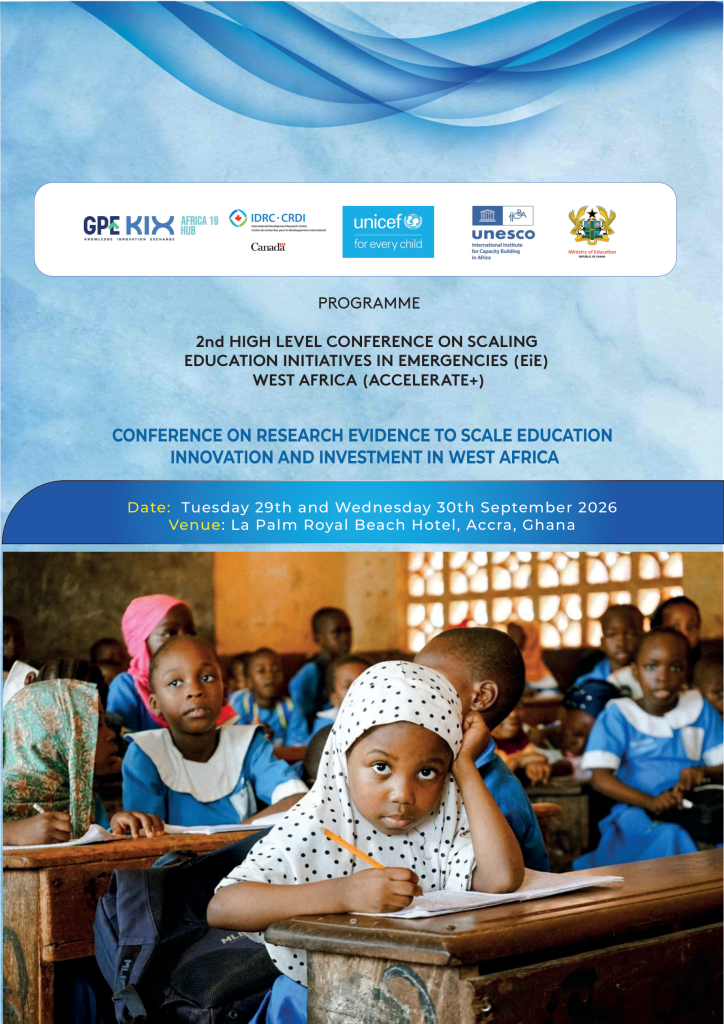
Abstract
Education systems across West Africa continue to face challenges in ensuring access to quality, safe, inclusive and uninterrupted learning for children and young people affected by emergencies and crises. While research initiatives have generated valuable evidence on education in emergencies, accelerated learning, foundational literacy, teacher wellbeing and inclusive education, translating promising innovations into sustainable policies, financing and large-scale implementation remains a significant challenge.
This conference document outlines a regional platform for bringing together policymakers, researchers, education practitioners, innovators and development partners to examine how evidence-based education innovations can be effectively scaled across West Africa. It focuses on identifying promising approaches, understanding the institutional and policy conditions required for successful scale-up, exploring sustainable financing mechanisms, and strengthening collaboration between research, policy and practice.
The conference aims to support the development of practical outputs, including a regional evidence synthesis, policy recommendations, an investment brief and an action roadmap to guide follow-up activities. By strengthening regional cooperation and promoting the use of locally generated evidence, the initiative seeks to inform policy decisions, improve investment in education, and contribute to more resilient, inclusive and responsive education systems for children and young people affected by crises.