

2nd High-Level Conference on Education in Emergencies (ACCELERATE+)
HIGH LEVEL CONFERENCE SYNOPSIS
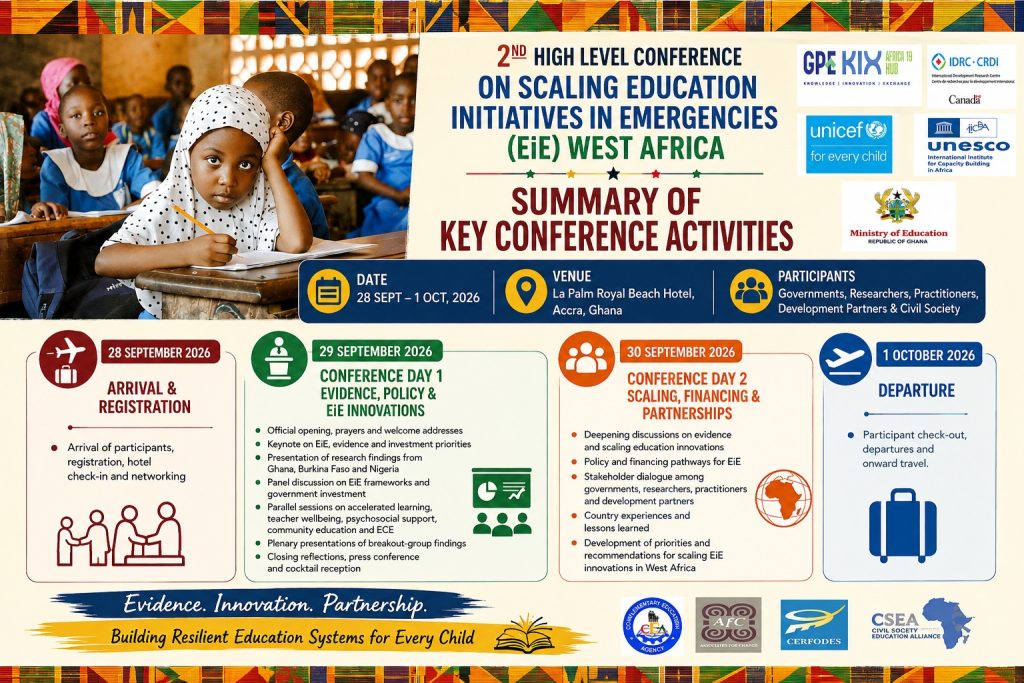
The 2nd High-Level Conference on Scaling Education Initiatives in Emergencies (EiE) – West Africa (ACCELERATE+) is a regional platform designed to bring together policymakers, researchers, education practitioners, innovators, development partners and financing institutions to advance the scaling of evidence-based education innovations in fragile, conflict- and violence-affected (FCV) contexts across West Africa.The conference, scheduled for 29–30 September 2026 in Accra, Ghana, responds to persistent disruptions to education caused by armed conflict, displacement, climate-related disasters, public health emergencies and socio-economic shocks. These crises disproportionately affect vulnerable children and young people, particularly girls and marginalized populations, by limiting access to safe and quality education and undermining learning outcomes. The concept note highlights the continuing challenge of translating the growing body of research and successful education innovations into policy, sustainable financing and large-scale implementation.
Rethinking Early Childhood Pedagogy, Curriculum and Co-creators of Knowledge: Insights from Participatory Community-Driven Research in Multidimensionally Deprived Rural Communities.
The study highlights the need to rethink early childhood education by recognising indigenous knowledge and community-based pedagogies as valuable educational resources, particularly in multidimensionally deprived rural communities. Using qualitative research involving parents from Nanton and Ekumfi districts in Ghana, the findings show that families intentionally support children’s learning through everyday cultural, social, environmental, emotional, cognitive, literacy, and numeracy activities embedded in daily life.
These practices form the basis of the Intentional Holistic Integration (IHI) Early Childhood Education Model, which demonstrates that learning is integrated into home and community experiences rather than confined to formal classrooms. The study argues that education policies and teacher training should acknowledge parents and community members as co-educators, integrate indigenous pedagogies into early childhood curricula, and adopt community-driven approaches such as the Scaling Inclusive Home-based Early Learning Initiative (SIHELI) to improve equitable access to quality early childhood education