

Overview Scaling Inclusive Home-Based Early Learning Initiative (SIHELI)
The Scaling Inclusive Home-Based Early Learning Initiative (SIHELI) is a 33-month implementation research project led by Kyambogo University (Uganda) in partnership with Associates for Change (Ghana) and Nimba University (Liberia). It pilots a hybrid early childhood education (ECE) model that combines home- and center-based approaches in
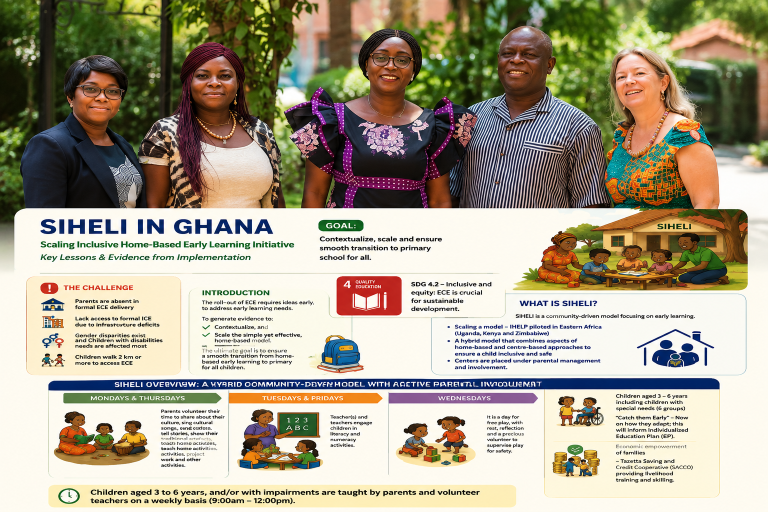
ECE to expand access for children aged 3–6 years in communities without formal schools. The model emphasises inclusion of children with disabilities and promotes gender-responsive, culturally relevant play-based pedagogy. Parental and community management structures are integrated, with health and nutrition linkages to support child development. In Ghana, SIHELI is being implemented with the Ghana Education Service (GES) in selected communities within the Nanton District in the Northern Region. The project ultimately seeks to generate evidence to inform policy and scale sustainable, community-driven early childhood education initiatives.
SCALING INCLUSIVE HOMEBASED EARLY CHILDHOOD INNITIATIVE(SIHELI) LIST OF OUTPUTS FOR GHANA
SIHELI CONCEPT NOTE
The Scaling Inclusive Home-based Early Learning Initiative (SIHELI) is a 33-month hybrid early childhood education model combining home-based and centre-based approaches across Uganda, Ghana, and Liberia. In Ghana, the project establishes five community-managed learning centres (Moya, Chahiyili, Kparigulanyili, Gushei, and Zali) in the Nanton District of the Northern Region, integrating health services, disability screening, parent education sessions, and livelihoods support including a Savings and Credit Cooperative Organisation (SACCO) for parents and livelihood training to address household economic constraints affecting childcare.
LITERATURE REVIEW: Understanding How Community Engagement, Play-Based Learning And Home-Based Early Learing Initiatives Affect Early Childhood Education And Development:
This comprehensive review synthesises global evidence on community engagement, play-based learning (particularly indigenous games), and home-based early learning interventions. It demonstrates that stakeholder participation and culturally grounded play pedagogies significantly enhance children’s cognitive, social, emotional, and physical development while identifying critical gaps in teacher training and integration of indigenous approaches within formal ECE systems.
SIHELI GENDER REPORT – Gender Equity in Early Childhood Care and Development: Insights From the SIHELI Project in Northern Ghana
This report examines gender dynamics in parental involvement in childcare across five rural communities in Northern Ghana (SIHELI communities). It reveals deeply entrenched social norms that restrict men’s childcare roles to provision and discipline while stigmatising direct nurturing as weakness. The SIHELI centres have shown promise in engaging men by reframing early learning as cultural preservation, creating legitimate spaces for father-child bonding and shifting community attitudes toward more equitable parenting.
SIHELI BASELINE STUDY: POLICY BRIEF
The policy brief documents that children aged 3-6 in Ghana’s Ekumfi and Nanton districts travel over 2km daily to access schooling or remain at home exposed to risks. Key findings reveal widespread community support for home-based learning centres, strong parental use of indigenous pedagogies, and a clear preference for mother-tongue instruction. It recommends allocating 15% of the ECE budget to community-based centres and integrating culturally relevant pedagogies into national curricula.
SIHELI BASELINE STUDY: SUMMARY OF KEY FINDINGS
This document summarises the key findings of the baseline study with a bit more details. It reveals strong community readiness to establish home-based ECE centres, with parents already engaging in informal play-based learning using locally sourced materials. Significant challenges persist including gendered caregiving roles, exclusion of children with disabilities due to stigma, and substantial teacher training gaps. It recommends community-driven solutions, structured teacher training, peer learning, and inclusive practices.
HEALTH ASSESSMENT REPORT
This report details the comprehensive health assessment conducted as a core component of the SIHELI project in the Nanton District of Northern Ghana. The primary objective was to systematically identify children with disabilities, special needs, or underlying health conditions that could adversely impact their educational participation and developmental trajectories. A multidisciplinary team screened approximately 150 children across five communities (Moya, Chahiyili, Kparigulanyili, Gushei, and Zali) in the areas of general pediatric health, vision, and hearing. While the screening confirmed that the majority of children are in good health, it successfully identified a significant subset requiring further specialist intervention, support, or assistive devices. The exercise highlights the critical need for integrated health and education services in rural Ghana and provides a clear roadmap for targeted follow-up actions to ensure all children can thrive in the SIHELI learning environment.